100 moments. 100 stickers. One summer that actually counts.

Connect the moments. Reveal the patterns that bring numbers to life.

[Pre-order now — limited to 100 families. Bundles ship by 17 July.]

The Problem

Summer is a great opportunity to relax, play and spend time in nature.

But when numbers fade into the background, the connections children are just beginning to build quietly fade. Not dramatically. Just enough that September feels harder than it should.

No one is asking them to notice. To guess. To wonder.

The Solution

100square is a kit that brings numbers back into the foreground — quickly, quietly, playfully, without it feeling like school. A poster, an app and 100 stickers that turn small moments into visible connections — patterns your child discovers and your family can see growing all summer.

Why It Works

Learning numbers isn't just counting. The first hundred numbers contain patterns and structures that most children never get the time to notice — relationships between numbers that make the whole system feel, eventually, intuitive rather than memorised.

100squares creates the conditions for those patterns to become visible. Not through lessons. Through small, repeated encounters. The kind that leave something behind, the way a detail noticed in a story comes back to mind later.

Your job isn't to explain. It's to be there when something gets noticed.

How It Works

  1. 1

    Set your learning moments

    Tell the app when moments work for your family. It handles the rest — sending alerts at the right time, with a snooze for when life gets in the way.

  2. 2

    Your child recognises a number

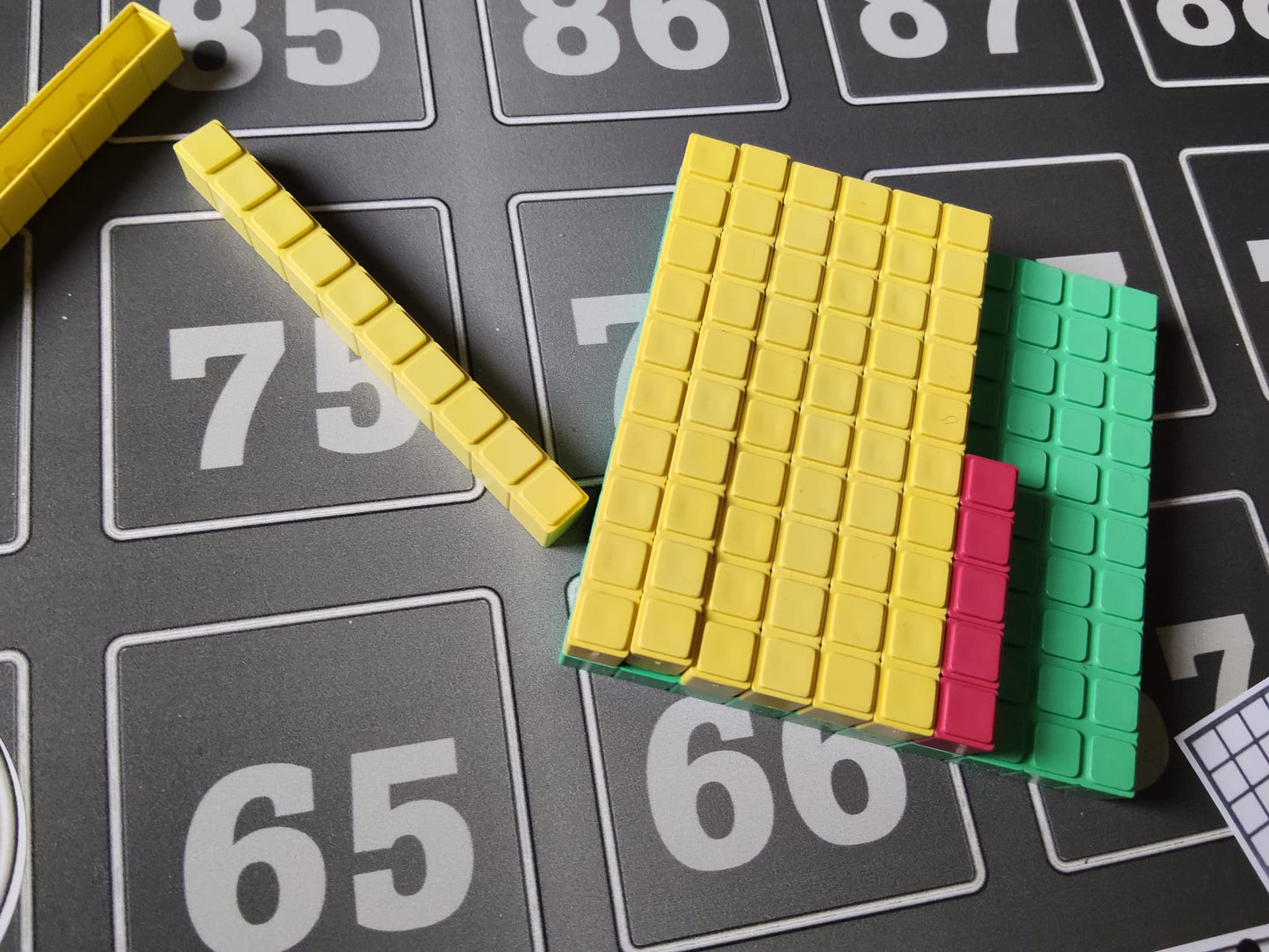
    The app sends a short challenge — a pattern that fades before your child's eyes. They say what number they think it is. No pressure. Just a moment of thinking. Build the number physically, like Lego, with the special blocks if helpful.

  3. 3

    Get it right enough times - earn a sticker

    When your child has shown they know a number, they earn the sticker for it. They get to know the number more deeply by recognising how it's built (and by physically building it)

  4. 4

    Place the sticker on the poster

    The hundred square on your wall fills gradually over the summer. Watch the patterns begin to appear.

  5. 5

    The poster sparks the conversations

    It stays in the foreground because it's being built. Numbers get noticed, compared, questioned. That's the learning — happening naturally, without anyone planning it.

Does It Actually Work?

Parents who've watched children work with number grids consistently report the same surprise — that something so simple reveals so much. Patterns they hadn't noticed themselves. Connections they weren't taught. Questions they didn't expect their child to ask.

That's not a coincidence. It's what happens when a familiar set of numbers gets a reason to be looked at carefully.

100squares is designed to create that reason — a hundred times over the summer.
We're running a pilot with 100 families this summer. We'll be sharing what we find.

Is This Right For My Child?

100square is designed for children who are beginning to make sense of numbers — but find it a struggle.

You might notice your child:

  • Needs prompting to work out even single digit additions
  • Uses fingers to add
  • Can count to 20 or beyond but not reliably
  • Muddles the order of numbers — confusing 14 and 41, or not sure whether 16 comes before or after 19.


If that sounds familiar, your child is at exactly the right moment for 100squares. What they need isn't more lessons — it's gentle, repeated encounters with numbers in a low-pressure setting. That's what 100squares is designed to give them. Not just this summer, but as a foundation that lasts.

Frequently Asked Questions

About the app

Q: I don't want my child to have any more screen time. Does this involve a lot?

A device is needed to give the number prompt and let the child respond to it. The app — ideally on a mobile for the full experience — is used for around 20 seconds per number prompt. You decide how many prompts you do in a session, but it's unlikely to be more than 10, which is 3 minutes of focused, non-addictive screen time at most.

Q: What data do you collect? Is there a subscription?

We don't collect any identifying data about your child. The app records how they respond to number challenges and how confident they feel, in order to generate follow-on prompts. There's no subscription and no ongoing cost after your summer purchase. Once you've worked through the first set, it's possible to extend the practice with new sticker sets.

About your child

What age is 100squares designed for?

100squares is designed for children aged 4 to 9, or any child who is still building confidence and familiarity with numbers up to 100. The app is designed with this age group in mind and may feel too young for older children — you'll be able to judge from the product description whether it suits your child.

My child seems fine with maths at school. Should I still be thinking about this?

If your child seems comfortable, that's great. 100squares is there to reinforce numbers and give children the time to notice patterns that can make maths feel more natural rather than memorised. It's not unusual for adults — including those with maths and science degrees — to notice something new when they encounter the hundred square this way. It's enrichment, not intervention.

What if my child finds it too hard?

In most cases it's a question of time — giving them the encounters they need at their own pace. If your child is not yet confident counting to 10 or recognising 2-digit numbers, 100squares can still be valuable as a way to notice patterns through the images and place value blocks, even before the sticker challenges feel accessible. If they need more time with counting and one-to-one correspondence first, that's fine — 100squares will be here when they're ready.


About the experience

How long should we spend on this each day?

As little or as much as suits your summer — there's no set amount. Most families start with a single number a day, which takes two or three minutes once the sticker goes on, and naturally do a bit more as their child grows in confidence. The app sets the pace, so it stays a small daily ritual rather than something you have to plan or keep on top of.

What does a typical 100squares session look like?

The app gives your child a number to find. They watch the worm, have a guess at where it will land, and tap in their answer; if they've earned a sticker, they place it on the poster, which slowly fills up across the summer. The whole thing takes two or three minutes, and your job is simply to be there and enjoy it with them — no teaching required.

What if we miss a day, or go away and can't take the poster?

Nothing breaks if you skip a day — this is a summer of small moments, not a timetable to keep up with. If you're away, your child can still do the number on the app, and the sticker just waits on the poster until you're home. The pace belongs to your child, not the calendar.

What if we put a sticker on the wrong square by mistake?


Not a problem at all — even better if your child spots it later. Putting it right together is a nice way to show that mistakes are just part of the fun. And they're easy to fix: a quick dab with a pen, or one of the white and black dot stickers included in the pack.